
mainmenu
- About Center
- Members
- Research
- Publications
- Facilities
- Super-depth Optical Imaging Lab
- Ultrafast Infrared Spectroscopy Lab
- Ultrafast IR-Visible Spectroscopy Lab
- Instrument and Chemistry Lab
- Molecular Imaging Lab
- Multidimensional Infrared Spectroscopy Lab
- Sample Preparation Lab
- Optical Frequency Comb Spectroscopy Lab
- Single Molecule Imaging Lab
- Spectroscopic Imaging Lab
- Theory and Computation
- Open Access Facility
- Collaborative Research Equipment
- Quantum Spectroscopy Lab
- Equipment Inventory
- Board
1-A. Background
A variety of spectroscopic methods that differ from one another by radiation frequencies, detection schemes, field-matter interaction pathways, and molecular dynamics, have been used in the entire scientific research fields.1-59 Although there exist a number of conventional linear and nonlinear optical spectroscopies, most of them can be classified into three groups, i.e, (a) absorption of the injected radiation, (b) spontaneous emission such as fluorescence and phosphorescence, and (c) coherent and incoherent scattering processes.
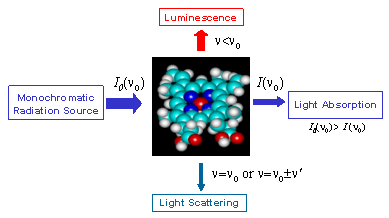
Frequency-Resolved One-Dimensional Vibrational Spectroscopies: The most fundamental radiation-matter interaction-induced effect is an absorption of a single photon by a molecular system. A typical example is the infrared absorption spectroscopy, where the external IR field photon is absorbed by a polyatomic molecule via a resonant quantum transition between two vibrational states. Thus, the infrared absorption spectrum provides direct information on the frequency distribution ({ }) of the vibrational degrees of freedom and their oscillator strengths that are related to the transition dipole moments, , where m and Qa denote the ground state dipole moment and ath normal mode coordinate, respectively. Another type of vibrational spectroscopy is to utilize Raman scattering process. The non-resonant Raman scattering spectroscopy uses electronically non-resonant visible field so that the field-matter interaction creates an induced dipole, and which is subject to another field-matter interaction to produce an inelastic scattered electromagnetic field. When the radiation field undergoes an energy loss of which amount is identical to a one quantum of vibrational degree of freedom, this process is the so-called Stokes Raman scattering. Therefore, the Raman scattering spectrum reveals normal mode frequency distribution and their inelastic scattering cross sections. Due to the different selection rules governing these two types of vibrational spectroscopies, the infrared absorption and Raman scattering spectroscopies have been considered to be complementary and served as fundamental research tools for studying structures and functional roles of molecules of interest.
Time-Resolved One-Dimensional Raman Spectroscopy: More than a decade ago, the first time-resolved Raman scattering measurement was demonstrated to be viable by a few groups of researchers. A laser pulse of which frequency is in non-resonance with electronic transition was used to create multiple Raman-active vibrational coherence states. Then, after a certain delay time later another laser pulse is injected to create third-order material polarization, and the scattered signal field intensity is detected. Although the time-domain Raman response function is directly related to the frequency-domain Raman scattering spectrum via the linear fluctuation-dissipation theorem, the low-frequency part of the spectrum, which are associated with the slow dynamics of intermolecular liquid vibrations, can be accurately determined by the time-resolved Raman spectroscopy.
Limitations of One-Dimensional Vibrational Spectroscopies in Either Time- or Frequency Domains: The conventional vibrational spectroscopies, either in time or in frequency domains, mentioned above are all one-dimensional, that is to say, signal intensity is a function of either frequency or pulse delay time. For some polyatomic molecules such as biological molecules, the one-dimensional vibrational spectra are extremely complicated and spectrally congested so that it is prohibitively difficult to achieve high spectral and spatial resolutions. Consequently, those vibrational interactions and coupling constants that are sensitively dependent on the precise three-dimensional molecular structure cannot be quantitatively measured from the spectrally congested 1D vibrational spectra. In this regard, various multidimensional vibrational spectroscopies, which has been studied by the CMDS over the last three years, have several advantages in comparison to those 1D vibrational spectroscopies, such as high specificity, enhanced spectral resolution, extreme sensitivity on 3D molecular structure, and ultrafast time resolution. As has been proven over the last few years, multidimensional vibrational spectroscopic methods can be of use in studying vibrational interactions of small molecules as well as in determining 3D structures of biological molecules like polypeptides in solution.
1-B. Conventional Protein Structure Determination Tools
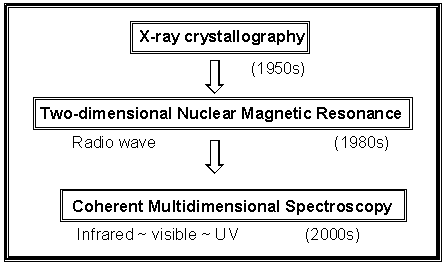
Two of the most incisive protein structure determination tools are (a) X-ray diffraction method and (b) two-dimensional NMR spectroscopy. History of the former technique, X-ray crystallography, goes back in 1950s and the latter, 2D-NMR for the purpose of structural analysis of proteins, has become widely used since 1980s. These two methods have both advantages and disadvantages (see Table 1). Although the X-ray crystallography can provide most definite information on 3D structure of a given protein, a crystalline sample has to be prepared. In strong contrast, the 2D NMR spectroscopy can be used to study 3D structure of a protein in solution by measuring nuclear Overhauser enhancement (NOE) effect or by measuring spin-spin coupling constants. However, the relative accuracy of 3D structure determined by the 2D-NMR is less reliable in comparison to the X-ray crystallography. One of the critical limitations of these two methods, X-ray crystallography and 2D-NMR, is that they cannot be used to study fast dynamics and conformational transitions of which time scales are less than miliseconds. For instance, protein folding time scale ranges from picoseconds to seconds, but the time-resolved 2D-NMR doesn’t provide any dynamical information on the folding process occuring less than a few miliseconds. Consequently, a number of researchers have been vigorously searching for an alternative experimental tool that can provide information on not only 3D structures but also dynamical evolution of their structures.
| Advantages | Restrictions | |
|---|---|---|
| X-ray | High spatial resolution | · Sample has to be prepared as a crystalline form. · Time-resolution is extremely difficult because an ultrafast X-ray pulse generation is prohibitively difficult. · No information on the vibrational energy relaxation and coupling pattern is provided by X-ray crystallographic investigation. |
| 2D-NMR | Solution sample can be studied | · Time-resolution is limited (longer than hundreds of microsecond) by the period of used radio-wave field. · High-resolution NMR spectrometer is expensive. · No information on the vibrational energy relaxation is provided by 2D-NMR measurement. |
Table 1. X-ray crystallography and 2D-NMR spectroscopy: Advantages and restrictions
1-C. Motivation: An Alternative Protein Structure Determination Tool
Over the last few years, there have been accumulated evidences that the coherent multidimensional spectroscopy can be the strong candidate for an alternative tool having both capabilities, i.e., structure determination and ultrafast time resolution. In particular, the research results over the last three years by the CMDS (Center for MultiDimensional Spectroscopy that has been supported by the Creative Research Initiatives Program of KISTEP since Oct. 2000) at Korea University have demonstrated that one can indeed achieve these goals in the near future.

Tel : +82-2-3290-4747
Copyright(c) 2014 Center for Molecular Spectroscopy and Dynamics. All Rights Reserved.